
Can Saints Help Us to Prepare for Lent?
Read Time: 7.5 minutes
Congratulations to us! We made it through the ten darkest weeks of the year! There were five dark weeks from November 18th to the winter solstice, December 21st, and there have been five more since, up to January 22nd. From here on in, we are blessed every day with more light. Even though Lent is approaching, life is getting brighter.
In the liturgical year, we are past the big Christmas celebrations and back into Ordinary time, which is a period when we reflect on Jesus’ life and ministry. During this time the readings focus on growth, and discipleship. These readings will help us to open up our hearts as we begin to prepare ourselves for the Lenten season of prayer, fasting, almsgiving and penance, beginning on Ash Wednesday, February 18th.
Lent is a tough, serious season for many, so before Ash Wednesday, it is good to have some saints’ feast days to celebrate. One of my favourite days to celebrate is that of St Brigid.
February 1st is the feast day of St Brigid and is designated in Ireland as the first day of Spring and, since 2023, is a National holiday. After St Patrick, St Brigid is Ireland’s second most beloved saint. She was born around 450 AD and died in 525. Her mother was a Christian slave who had been baptized by St Patrick and her father was a wealthy pagan chieftain. She was freed from slavery after her father brought her to the king, intending to sell her, but the king noticed that Brigid was helping a leper by giving away her father’s jeweled sword. The king recognized Brigid’s goodness and kindness and ordered her to be freed from slavery. Brigid’s mother was in charge of the royal dairy and so Brigid helped her mom and eventually took over. The dairy prospered and her mother was freed from slavery.
Brigid became known for her kindness and generosity, feeding the hungry and providing clothes to those who were in need, often giving away whatever she had. She believed that no one should suffer when others had plenty.
As she grew older, Brigid chose a religious life, eventually becoming a strong, dedicated leader. She wanted to build a church and she needed land. A story is told that she went to see the king to make her request for land. The king laughed at her, but somehow agreed to give her whatever piece of land could be covered by the cloak she was wearing. Brigid prayed and then instructed her companions to each hold a corner of her cloak and walk as far as they could. To the king’s amazement, the cloak stretched to cover many acres of land and he realized that Brigid had been blessed by God. He knelt before Brigid and agreed to give her the land she had requested and promised to help her and her friends with supplies and money. Soon after he became a Christian.
Brigid went on to found a great monastery and many churches all over Ireland. Under her guidance this monastery became a center of learning, healing and spirituality. She travelled extensively and is also said to have founded a school of art, which produced manuscripts and metalwork.
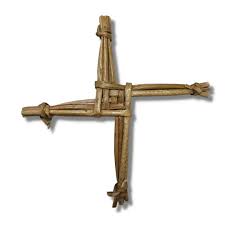
Another story about St. Brigid concerns the famous St Brigid’s cross, which is traditionally made from woven rushes or straw. The story is that Brigid was looking after and nursing a pagan lord who was on his deathbed. His servants sent for St.Brigid to help him. She stayed with him and comforted him. To help pass the time, she picked up some rushes from the floor and wove them into a cross, to try to explain her faith. As Brigid explained the cross, her words comforted the dying man and he asked to be baptized before he died.
It has now become an Irish tradition to make these crosses each year, in preparation for the feast of St Brigid. The crosses are placed over the door of the house and a prayer is said to St Brigid asking for protection
There are several saints whose feast days are celebrated before Lent begins, but I will just mention three more:
February 3rd is the feast day of St. Blaise, who is known for the tradition of blessing throats. Born in Turkey, he was a physician and later became a bishop. He was famous for healing illnesses, particularly throat ailments. One story tells about the miraculous cure of a boy who was choking to death on a fishbone. St. Blaise was persecuted, captured, tortured and beheaded around 316 AD.
On his feast day, in some churches, there is the tradition of the blessing of the throats, where priests bless throats with two crossed candles. He is the patron saint of throat illnesses, wool combers and animals.
Another saint whose feast day is before Lent, is St. Scholastica. She is the twin sister of St. Benedict and her feast day is February 10th. Born in 480 to wealthy parents, the twins grew up together until St. Benedict left to go to Rome to study. He established the Benedictines for men and she also established a religious community, Benedictines, for women, close to her brother’s community.
The twins remained close throughout their lives but only allowed themselves one personal visit each year. These two gave themselves totally to God. They sacrificed the social time they could have spent together in order to fulfill their vocations to religious life.
These stories about saints are helpful in preparing ourselves for Lent. Although Brigid, Blaise, Scholastica and Benedict lived at different times, in different places and under very different circumstances from us, they still inspire us, showing us how to live a holy life. As we approach the Lenten season, these saints prove to us that it is possible to live a holy life, that it is possible to change and grow closer to Jesus.