
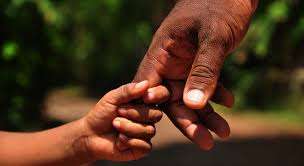
The Language of Love
Read time: 8 minutes
The Language of Words are our primary means of expression followed closely by gesture and body language – one of the drawbacks of written letters and especially “text” is that context is difficult if not impossible to convey without visible cues.
Prayer is like that. We place our needs before God, thanking God for graces, and praising God for God… being God.
Filling the blankness with rote prayers often helps in our compulsion “to do and accomplish”. It not only occupies us productively, but we like to believe it shows our sincerity — and it does.
But sometimes, as Paul said, we don’t know how to pray. We are left speechless, floundering in confusion or simply drawing a blank. The Holy Spirit helps us pray in our heart.*
Then there is the language of silence where we allow ourselves to be open and vulnerable in “peace and silence”, turning our souls to God, humble enough to admit and to own what God already knows.
“Peace and silence” however, are ideals to strive for — sometimes I manage to “peace” my prayer time to only 60 distractions per minute.
There is another language as well, equally if not in some ways more important than spoken and written words — the language of ritual.
The rituals of our practices, whether individual prayer times or the celebration of the Eucharist, are expressions of our deepest feelings, whether in wordless silence or in gathered worship.
I’ve wondered – does our Omnipotent, Omniscient, Omnipresent God, “need” human worship?
To be clear, our regular worship whether on Sunday or daily Mass attendance, or personal prayer, is entirely appropriate; they are necessary from several perspectives.
First, the Eucharist is the mystery of Christ’s Real Presence. It is less to be understood than it is to be entered into, participated in, and allowed to happen in trust beyond quantifying or explaining.
St. Augustine said, “Be what you see, and receive what you are”. (Sermon 272).
It is a “communal celebration” – not a celebration as party entertainment, but a gathering in joy and gratitude for God’s love and grace.
It is a time of communal devotion where personal prayer and devotion have a place – but the point is the communal gathering.
We come to Mass with our personal intentions; we can also request a Mass dedicated to those intentions, but it is always in the spirit of the community praying with us rather than our withdrawal into our private world.
Worship is not about “me and God”, it’s about “us and God”.
Secondly, worship is not something God needs — it is something we need. Angels in heaven exalt God’s majesty without beginning and without end.
The point is neither our songs of praise nor our begging for mercy and forgiveness. Of course, our song is a wonderful expression of devotion, and we appropriately call to mind asking, “the blessed Mary ever-Virgin, all the Angels and Saints, and you, my brothers and sisters, to pray for me to the Lord our God” in our communal confession.
Our worship reminds us that, God is God, and we are not God.
For at least an hour once a week we come to acknowledge something greater than ourselves.
We offer each other a sign of peace. Pre-COVID, it was common to offer a handshake, or hug family and close friend near us. A handshake and a hug are also important rituals.
A handshake requires a touch, a hug implies an intimacy of closer friendship that words cannot express, and a kiss goes beyond these both. A kiss is the most intimate of all expressions of closeness. Ironic that Judas betrayed Jesus with a kiss; the symbolism goes beyond this blog.
These are all of the physical realm that express an inner truth. Jesus went beyond these to give us his body and blood to sustain us and call us back to His truth.
Pope Francis reminds us that, “The Eucharist… is not a prize for the perfect but a powerful medicine and nourishment for the weak” *. In that vein, church is as much a “field hospital” for those working with and on their faith as it is anything else.
The Mass is a ritual that humbles us to recognize that as hard as we work and as much as we have “earned” our place in society, we are all equal in the presence of God.
We come together as equals in the sight of God – to support each other… as equals. Nothing can be deeper or more personal.
Gandhi is attributed to have said, “I like your Christ, I do not like your Christians”.
He deeply admired the Sermon on the Mount, but his view of institutional Christianity changed after a white usher turned him away from a church in South Africa. He was told that the building was for (white) Europeans.
His experience is a sad testament to our “exclusivity” and the many forms it takes — as overt as a “white church” calling itself Christian, to “Christian nationalism” whereas in colonial times, we denigrate the wisdom in other religions.
There is truth; truth offers itself to us in many forms, languages, and expressions.
Though it may be expressed differently than we would express it, the expression does not make it any less true.
We are reminded that in relation to God, we are but “a particle in the vastness of the universe”, yet we are also all uniquely precious to God.
Our Sunday ritual is the language of love – our love for God can only be truly expressed through our care and concern for others. God’s love for us is expressed in giving us Godself to sustain us.
There is a priest who would end Mass with, “The Mass is over, let the service begin” – the best summary of the point of it all that I can imagine.
* Romans 8:26. “…the Spirit too comes to help us in our weakness, for, when we do not know how to pray properly, then the Spirit personally makes our petitions for us in groans that cannot be put into words…”
** Evangelii Gaudium, p.40